Downtown Juneau has two places to begin with the Tlingit people whose land this is: the Alaska State Museum, the state’s own, at 395 Whittier St., and Sealaska Heritage Institute’s Walter Soboleff Building at 105 Heritage Way, with a clan house clad in hand-adzed cedar and the Nathan Jackson Gallery. This page is for both of our readers, the cruise passenger with a day in port and the independent traveler, in summer or in winter: each museum’s hours and prices by season, each dated, how they fit a port day, and the Tlingit names of the place. Every clock time on this page is Alaska Time: AKST (UTC-9) until 14 March 2027 and again from 7 November 2027, AKDT (UTC-8) in between.
Juneau’s Tlingit name, and whose land it is
Juneau stands in Lingít Aaní, Tlingit land. The City and Borough of Juneau (CBJ) counts 21 recorded ancestral territories in Lingít Aaní, each called a kwáan and each named for a place on the land, and two of them take in the borough: the Aak’w Kwáan, named for the lake near a winter village north of downtown that no longer stands, and the T’aaku Kwáan, named for the Taku River, south of downtown. Sealaska Corporation, the regional Native corporation, places the Aak’w Kwáan at the Auke Lake area: what is now downtown Juneau was its summer fish camp, and its winter camps were at Point Louisa, near the Auke Recreational Park. The T’aaku Kwáan, the Taku people, lived near the Taku River. In August 2026 the Alaska State Museum’s visitor page named the Tlingit as the people upon whose traditional lands the museum stands.
Juneau’s own Tlingit name is Dzantik’i Héeni, as Sealaska Corporation heads its Juneau page, and its sentence on it reads: “It is said, Juneau is officially called Dzantikʼi Héeni (little flounder stream).” CBJ’s audio walk, Juneau Voices, writes the name as one word, Dzantik’ihéeni, and gives Juneau a traditional name that it translates as “The Place That Has Everything”: fish, deer, Dall sheep, forests, gold and stories. Sealaska Heritage Institute and the Central Council of the Tlingit & Haida Indian Tribes of Alaska print the name of the city’s middle school as Dzantik’i Heeni, without the accent.
The spellings differ from source to source. CBJ writes Áak’w Kwáan and T’aaḵú Kwáan, and the Central Council writes Áak’w Ḵwáan; this page follows Sealaska Heritage Institute’s Aak’w Kwáan and T’aaku Kwáan, and its Lingít for the Tlingit language.
The town grew from gold. In 1880, Sealaska Heritage Institute records, Chief Kaawaa’ee, a Tlingit of the Aak’w Kwáan, led Joe Juneau and Dick Harris to gold, and thousands of miners and settlers followed. The Organic Act of 1884 gave title to land held by non-Native people in the new territory but did not let Alaska Natives acquire title to theirs, and Tlingit people who tried to file mining claims were refused because they were not United States citizens.
Tlingit society has two halves, the Ravens or Crows (Yéil, Ts’axweil) and the Eagles or Wolves (Ch’áak’, Gooch), and a Tlingit belongs to the mother’s clan. Each clan has at least one crest, and the crests of Juneau’s own clans include the dog salmon, the shark, the wolf and the frog (CBJ). The Mendenhall Glacier’s two Lingít names are on our Mendenhall Glacier page.
The Alaska State Museum
The state museum is at 395 Whittier St., in the Andrew P. Kashevaroff (APK) Building, about three-quarters of a mile, some 16 minutes on foot at a level pace, from the base of the Goldbelt Tram by the cruise docks, and about a third of a mile, 7 minutes, from the Downtown Transit Center. Its hours and admission change with the season:
| Winter, as the museum gave them on 20 November 2026 | Summer 2026 | |
|---|---|---|
| Open | Tuesday to Saturday, 10 a.m. to 4 p.m. Alaska time | Tuesday to Sunday, 9 a.m. to 4:30 p.m. AKDT; Monday, 1 to 4:30 p.m. AKDT |
| Closed | Sunday and Monday | None |
| General admission | $9 | $14 |
| Seniors, 65 and up | $8 | $13 |
| 18 and under | Free | Free |
| Active-duty military and family | Free | Free, with military ID |
| Where it is from | The museum’s visitor page, last updated 6 November 2026 | The same page in May and August 2026 |
Winter’s times are AKST through 13 March 2027 and AKDT from 14 March. The visitor page names no season, but its own history shows which is which: it gave “Winter Rates” of $9 and $8, with the same Tuesday-to-Saturday hours, on 30 October 2025 and 24 March 2026, and “Summer Rates” of $14 and $13, open daily, by 18 May 2026. Summer 2027’s hours and rates were not posted on 20 November 2026. The museum’s free guided tours are in the Bloomberg Connects app: the museum advises downloading it before you go in, because cell coverage can be spotty at the back of the gallery.
Through 20 March 2027 the museum shows Miscellaneous Events of the Day, by the Lingít weaver Shgendootan George of Angoon, a housemaster of the Killer Whale Tooth House. Its Lingít title, Yee een kakkwalaneek yáa Aangóont akawdulgaaní, translates as “I will tell you all the story of when Angoon was set afire”: ten robes, in Chilkat and Raven’s Tail weaving and button blankets, tell the U.S. Navy’s bombardment of her village in 1882, from the days before the shelling through survival and rebuilding to the Navy’s apology in 2024, with photographs, drawings and ship’s logs beside them (the museum’s events page, last updated 3 November 2026).
Sealaska Heritage Institute and the Walter Soboleff Building
Sealaska Heritage Institute (SHI) is a tribal organization, founded in 1980 by Sealaska, the regional Native corporation for Southeast Alaska, after the first Sealaska Elders Conference, to perpetuate and enhance Tlingit, Haida and Tsimshian cultures. It is not Sealaska Corporation: the institute is a separate nonprofit, though two Sealaska directors sit on its board.
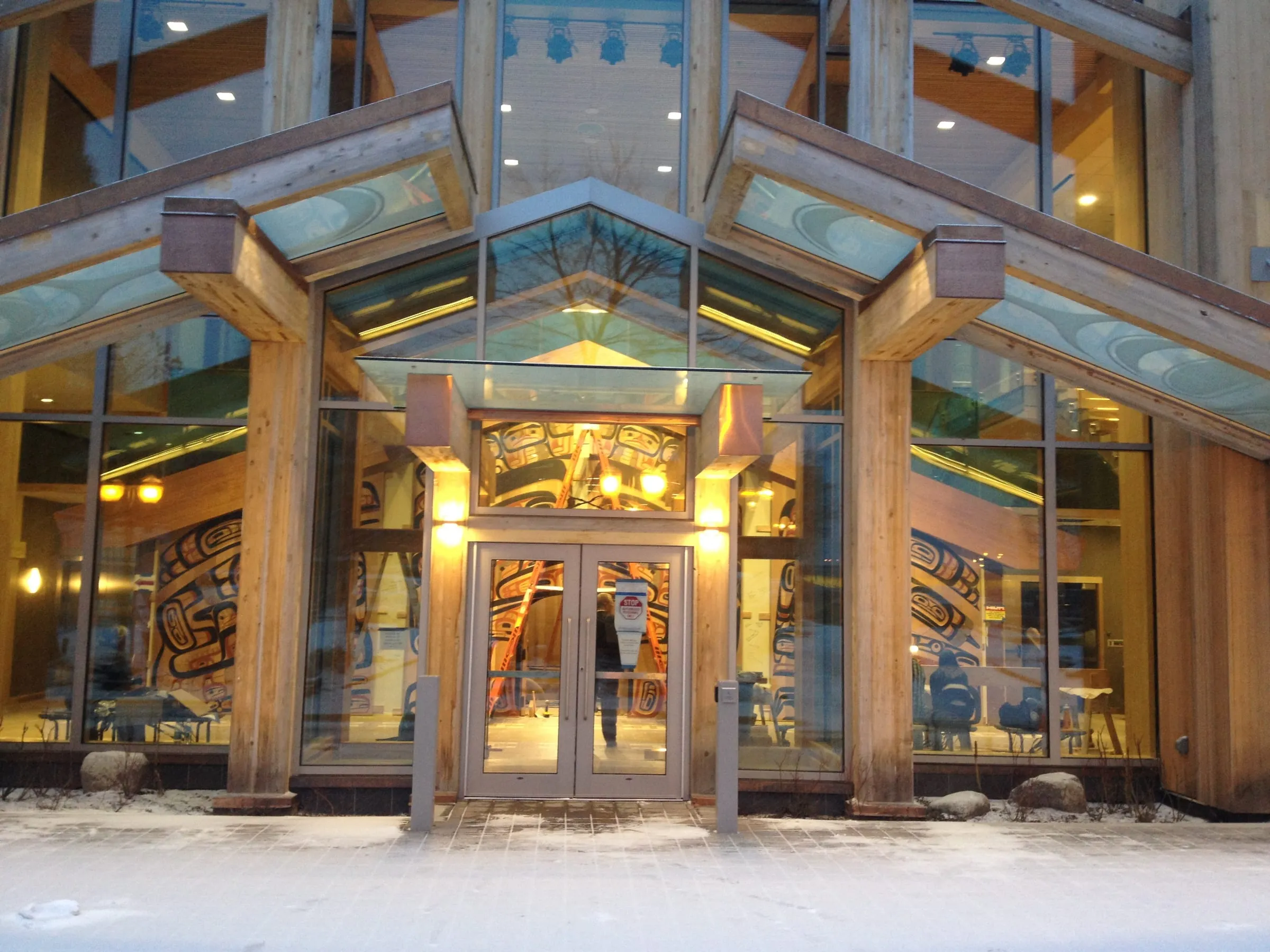
Its home since May 2015 is the Walter Soboleff Building at 105 Heritage Way, downtown, named for Dr. Walter A. Soboleff, a Tlingit of the Raven moiety and the Dog Salmon clan, who worked for Native civil rights all his life and died in 2011 at 102. SHI likens the building to a bentwood box that holds its at.óowu, its treasures. Its exhibits are on the first floor, and the building holds Shuká Hít (Ancestors’ House), a traditional clan house clad in hand-adzed cedar, named at the building’s opening; large works by Robert Davidson, David Boxley, Preston Singletary, Steve Brown and Wayne Price; the institute’s archives and classrooms; the Sealaska Heritage Store; and the Nathan Jackson Gallery. SHI’s visiting hours at 105 Heritage Way, the gallery’s too, are 10 a.m. to 6 p.m. AKDT, daily, in summer, and in winter Tuesday to Saturday, 10 a.m. to 6 p.m. Alaska time, closed on Sundays and Mondays; SHI says they are subject to change for special events and holidays (its contact page, read 20 November 2026). The photograph after this article shows the building’s glass entrance in 2015, with formline art behind the windows.
On 20 November 2026 SHI listed one exhibit as on view: Our Grandparents’ Names on the Land, on the ancient place names of the land and the tools Native people invented to catch halibut and salmon, in three interactive sections: Native Voices on the Land, Salmon People, and Halibut, Attack the Hook!
The ticket at the end of this page is Viator’s Nathan Jackson Gallery Admission Ticket, which SHI supplies itself: a visit at your own pace, which SHI puts at 1.5 to 2 hours, taking in monumental Northwest Coast art, Shuká Hít, the exhibits and a 22-minute film. It is untimed and sold per person, $25 for ages 12 to 64 and $17 for 65 and up, with no child’s ticket; it must be bought at least 24 hours ahead, and it is free to cancel up to 24 hours before. Viator sells it for every day from 20 November 2026, Sundays and Mondays included, so in winter choose a day from Tuesday to Saturday, when SHI is open. Viator lists every area as wheelchair accessible, and strollers and service animals are welcome. It has no reviews on Viator yet.
Outside, SHI’s Kootéeyaa Deiyí, the Totem Pole Trail, runs along the downtown waterfront and forms a way into Heritage Square, where the institute’s buildings stand. SHI plans 30 poles (kootéeyaa is Tlingit for totem pole). The first 12, by 10 Tlingit, Haida and Tsimshian master artists and their apprentices, went up in 2022 and were dedicated in 2023 with Faces of Alaska, five bronze masks for the Inupiat, Yup’ik, Alutiiq, Athabascan, and Tlingit, Haida and Tsimshian peoples. Each pole has its own interpretive sign.
The Juneau-Douglas City Museum
The city’s own museum is at 114 W. 4th Street, downtown. CBJ set its hours for October to December 2026 as Wednesday to Saturday, 11 a.m. to 4:30 p.m. Alaska time, with admission free that quarter, paid for by its sponsors. From July to September 2026 it kept the same days and hours, AKDT, at $7, $6 for 65 and older, and free for 12 and younger with an adult. CBJ’s museum page gave no 2027 hours on 20 November 2026. Our Juneau itinerary puts the museums in a day downtown with the State Capitol.
Juneau Voices: the clans’ welcome on the seawalk
CBJ’s Juneau Voices is an audio walk of 10 stops, each a Juneau resident’s story of the place. Its first is at the welcoming signs along the downtown seawalk, where spokespeople of the original Tlingit clans of the Aak’w Kwáan and the T’aaku Kwáan greet you, a Raven and an Eagle or Wolf from each, each introducing themselves by Tlingit protocol: name, moiety, kwáan, clan and clan house, the names of their mother and maternal grandmother, and their father’s. CBJ’s page for the first stop carries the transcript of its audio story.
On a cruise day
CLAA’s 2027 calendar for Juneau (its update of 2 October 2026) lists 699 calls from 24 April to 12 October 2027, and the shortest are 6 hours, all seven from 3:30 to 9:30 p.m. AKDT. On a morning or midday call, allow the State Museum 90 minutes inside and about 16 minutes’ walk each way from the Goldbelt Tram’s base, about 2 hours in all; the walk from your own dock is on our Juneau cruise port page. On one of those 6-hour calls the State Museum, which closed at 4:30 p.m. AKDT in summer 2026, leaves under an hour, so take Sealaska Heritage Institute’s gallery instead: Viator’s ticket is untimed, for 1 hour 30 minutes to 2 hours, and SHI gave its summer visiting hours as 10 a.m. to 6 p.m. AKDT, so go straight there. Buy it at least 24 hours ahead. Our margin is to be back at your dock an hour before the all-aboard time in your ship’s daily program, which comes before the sailing time on CLAA’s calendar.
Two things to check against your day. In summer 2026 the State Museum opened on Mondays only at 1 p.m. AKDT. And a ship in late April or early May may find it still on winter hours, closed on Sundays and Mondays: in 2026 its page still gave winter rates on 24 March and summer’s by 18 May.
In winter
No cruise ship calls before 24 April 2027 on CLAA’s calendar, and the State Museum is open Tuesday to Saturday, 10 a.m. to 4 p.m. Alaska time, for $9, as it gave its hours on 20 November 2026; Shgendootan George’s robes are there until 20 March 2027. In winter Sealaska Heritage Institute opens the Walter Soboleff Building, with the Nathan Jackson Gallery, Tuesday to Saturday from 10 a.m. to 6 p.m., and closes it on Sundays and Mondays. The city museum’s hours for October to December 2026 are above. Our Juneau in winter page has what else is open and closed this winter, each dated from its own source, and our getting around Juneau page the buses.